


Why Buy a Rare Gemstone?
When choosing a gemstone, it is easy to focus on familiar names such as diamonds, sapphires, rubies and emeralds. These stones are beautiful and widely recognised—but they represent only a small part of the extraordinary world of natural gemstones.
Rare gemstones offer something different. They combine natural beauty, geological scarcity and individuality in a way that mass-market jewellery cannot easily reproduce.
So, why would you buy a rare gemstone?
You Are Buying Something Genuinely Uncommon
A gemstone may be considered rare because it is found in only one or two locations, occurs in extremely limited quantities, or seldom produces material suitable for cutting into a fine stone.
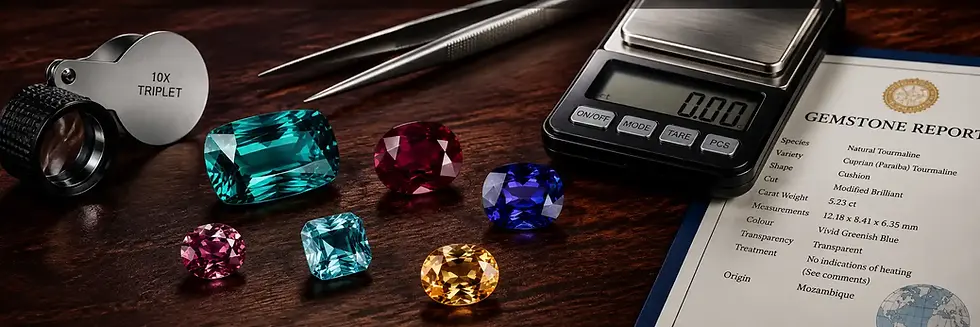
Cuprian tourmaline is an excellent example. Its remarkable blue, green and turquoise colours are produced by traces of copper, sometimes in combination with manganese. The finest specimens can display an electric, almost glowing appearance that distinguishes them from more common tourmalines.
Significant deposits of this material are scarce, and only a small proportion of the rough recovered has the colour and clarity required to become a collector-quality gemstone.
When you purchase a rare gem, you are acquiring something that nature has produced only under very unusual circumstances.
Every Rare Gemstone Is Individual
Mass-produced jewellery is designed to be consistent. Rare gemstones are valued for almost the opposite reason: each one is different.
A natural gem can have its own combination of:
Colour and colour distribution
Clarity and internal characteristics
Cut, proportions and brilliance
Carat weight
Geographic origin
Treatment history
Overall character
Even two gemstones of the same variety and similar size can look noticeably different. One may have stronger saturation, another greater brilliance, and another a particularly attractive balance of colour and clarity.
This individuality allows you to select a gemstone that appeals to you personally—not simply one that meets a standard description.
Rare Gemstones Can Have Extraordinary Colour
For many buyers, colour is the most compelling reason to choose a rare gemstone.
Nature can produce colours that are difficult to capture accurately in photographs:
the vivid blue-green glow of fine cuprian tourmaline,
the intense red of a quality ruby
the deep violet-blue of tanzanite or
the warm golden and imperial tones found in exceptional topaz.
A remarkable gemstone can change subtly under different lighting conditions. It may appear lively and brilliant in daylight, deeper under indoor lighting, or display flashes of contrasting colours as it moves.
This interaction between colour, light and cut gives a fine gemstone a presence that is difficult to appreciate until it is seen in person.
You Can Create Truly Personal Jewellery
A rare gemstone provides the perfect starting point for a one-of-a-kind piece of jewellery.
Instead of selecting a completed ring or pendant from a display cabinet, you can begin with the gemstone itself and have a setting designed around its individual shape, proportions and colour.
The finished piece might celebrate:
An engagement or wedding anniversary
A significant birthday
A family milestone
A personal achievement
A connection to a particular colour or place
The beginning of a family heirloom
Custom jewellery built around an uncommon gemstone is unlikely to be duplicated. It becomes an expression of the person who selected it and the person who wears it.
A Rare Gemstone Can Become a Family Heirloom
Fine gemstones can endure for generations when they are appropriately chosen, set and cared for.
Over time, a special gemstone may acquire a story that extends beyond its geological origins. It may become associated with an engagement, anniversary, achievement or loved one before eventually being passed to another generation.
The stone’s emotional value may then become as important as its financial value.
Documentation can help preserve that story. A reputable gemmological report, purchase records, photographs and details about the gemstone’s origin should be retained and passed on with it.
Collecting Rare Gemstones Is Fascinating
Some people buy one rare gemstone for a special piece of jewellery. Others become enthusiastic collectors.
Gemstone collecting can introduce you to geology, mineralogy, colour science, cutting techniques and the history of famous mining regions. Collectors may specialise in one gem variety, stones from a particular country, unusual colours or exceptional examples of several different species.
The enjoyment does not come only from ownership. It also comes from learning why a gemstone is rare, how it formed, where it was discovered and which characteristics make one specimen more desirable than another.
A thoughtfully assembled collection can reflect years of knowledge and personal taste.
There Is a Limited Supply of Exceptional Material
Not every rare gemstone is valuable, and rarity alone does not guarantee desirability. Quality remains critical.
However, the supply of fine natural gemstones is inherently limited. Mines can become depleted, production can decline and high-quality rough may become increasingly difficult to obtain. Even when a new deposit is discovered, there is no guarantee that it will produce large quantities of gem-quality material.
This is particularly relevant to stones combining several desirable qualities, including:
Attractive and highly saturated colour
Good transparency
Minimal visible inclusions
A skilled, well-proportioned cut
Useful size
Limited or no treatment
Reliable identification and documentation
Large gemstones that satisfy all these criteria can be significantly rarer than smaller or lower-quality examples of the same variety.
Rare Gemstones May Offer Collectable Value
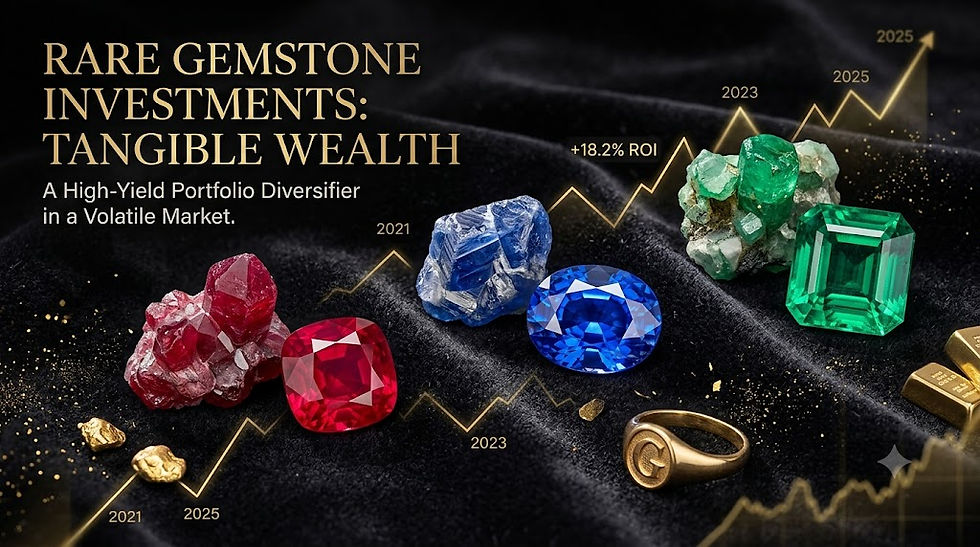
Some buyers are attracted to the possibility that an exceptional gemstone may retain or increase its value over time. Scarcity, quality, provenance, market demand and changes in supply can all influence future prices.
However, gemstones should not be promoted as guaranteed investments. They do not have the same pricing transparency or liquidity as shares, cash or widely traded commodities. Selling a gemstone quickly may also mean accepting less than its estimated retail value.
For this reason, it is generally sensible to buy a rare gemstone first because you appreciate its beauty, individuality and collectability. Any future increase in value should be viewed as a possibility rather than a promise.
Independent advice may be appropriate if investment is a major reason for the purchase.
You Can Own a Small Piece of Natural History
Every natural gemstone is the product of geological processes that may have begun millions—or even hundreds of millions—of years ago.
Heat, pressure, mineral-rich fluids and unusual chemical conditions had to combine in precisely the right way. The resulting crystal then had to survive geological change, be discovered, extracted and placed in the hands of a skilled cutter.
Thinking about this journey can make a rare gemstone feel very different from an ordinary manufactured luxury item. It is a tangible piece of the Earth’s history, shaped by nature and revealed through human craftsmanship.
What Should You Look for When Buying?
The word “rare” is sometimes used too loosely, so buyers should look beyond promotional descriptions.
Before purchasing, consider:
Identity: Has the gemstone been correctly identified?
Colour: Is the colour attractive, evenly distributed and appropriately saturated?
Clarity: Do inclusions interfere with its beauty or durability?
Cut: Does the gemstone return light well, or does it have obvious dark or transparent areas?
Treatment: Has it been heated, filled, irradiated or otherwise enhanced?
Origin: Is a claimed geographic origin supported by appropriate evidence?
Documentation: Is there a report from a recognised gemmological laboratory?
Condition: Are there chips, scratches, abrasions or other damage?
Seller credibility: Is the description clear, accurate and transparent?
A laboratory report does not determine whether you personally find a gemstone beautiful, but it can provide important information about its identity and detectable treatments.
Buy Something You Will Enjoy
The strongest reason to buy a rare gemstone is also the simplest: it speaks to you.
You may be captivated by its colour, fascinated by its origin or excited by the opportunity to create a completely individual piece of jewellery. You may want to begin a collection or choose something meaningful to pass on to your family.
Whatever your motivation, take time to compare gemstones and learn what makes each one special. Look for quality, reliable documentation and a stone that continues to hold your attention every time you see it.
A truly rare gemstone is more than an attractive object. It is a natural treasure with its own character, history and story—and, when carefully selected, it may become part of yours.
Discover a Remarkable Rare Gemstone
Amazing Rare Gems offers selected collector-quality gemstones from a private collection assembled over more than 30 years. The collection includes magnificent cuprian tourmalines, rubies, tanzanites, topaz and other distinctive natural gems.
Explore the available gemstones and discover one that could become an exceptional piece of jewellery, a treasured collectable or a lasting family heirloom.
Comments