


Are Rare Gemstones a Good Alternative Investment?

The Collector Who Looked Beyond Shares and Property
In 2005, a successful business owner we'll call David found himself in a familiar position. His investment portfolio contained a mix of shares, property, cash, and superannuation. While his investments had performed reasonably well, he was increasingly concerned about having too much exposure to traditional markets.
Property prices seemed cyclical. Share markets could be volatile. Interest rates moved up and down. David began looking for alternative assets that weren't directly tied to the performance of stock exchanges or real estate markets.
Like many investors, he initially considered gold.
Then he discovered rare gemstones.
At first, it was simply curiosity. He visited gem exhibitions, spoke with dealers, and started learning about gemstones he had never heard of before. Names such as Alexandrite, Cuprian Tourmaline, Spinel, and Paraiba Tourmaline opened a door to a fascinating world that combined natural beauty, geology, rarity, and wealth preservation.
What began as a hobby eventually became a serious collecting passion.
And along the way, David learned an important lesson: the rarest assets are often the ones most people know the least about.
Why Investors Are Looking Beyond Traditional Assets
For decades, investors have relied on a relatively small group of asset classes:
Shares
Property
Bonds
Cash
Precious metals
These investments remain important, but many investors are now seeking diversification through alternative assets.
Alternative investments may include:
Fine art
Collectible cars
Wine
Rare coins
Luxury watches
Rare gemstones
The attraction is simple. These assets often have value drivers that are different from traditional financial markets.
A rare gemstone does not generate earnings like a company share. Nor does it produce rental income like a property.
Instead, its value is largely determined by scarcity, desirability, and collector demand.
In many cases, there is simply no way to manufacture additional supply.
The Power of Scarcity
Unlike shares, which can be issued by companies, or property developments that create new housing stock, the supply of many rare gemstones is fixed by nature.
Some gemstones are found in only a handful of locations worldwide.
Others come from mines that have long since been exhausted.
This scarcity creates an interesting dynamic.
When demand increases, supply often cannot respond.
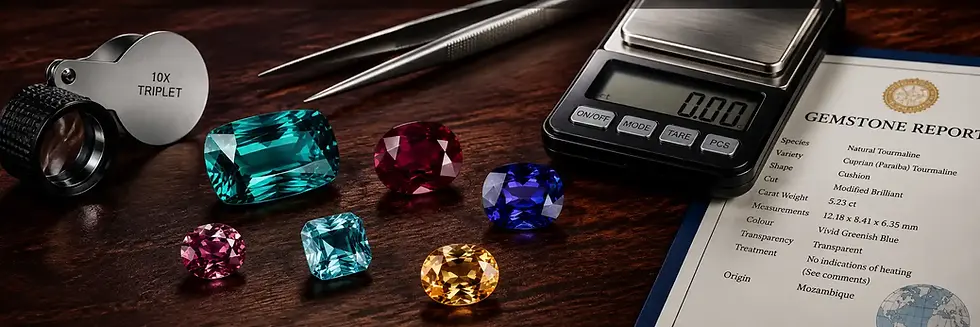
Imagine a collector searching for an exceptional Cuprian Tourmaline displaying intense neon blue-green colour and excellent clarity.
There may only be a small number of comparable stones available globally.
If several collectors compete for those same stones, prices can rise rapidly.
Nature cannot simply create more.
That is one of the characteristics that attracts collectors and investors alike.
Beauty Meets Investment
One aspect that sets gemstones apart from many investments is that they can be enjoyed while they are owned.
A share certificate sits in a portfolio.
A term deposit remains in a bank account.
A rare gemstone can be admired, studied, displayed, worn, and passed through generations.
Collectors often speak about the emotional value of gemstones.
Each stone has a story.
It may have formed millions of years ago deep within the Earth's crust. It may have been discovered in a remote mining region and carefully cut to reveal its full beauty.
For many collectors, this combination of beauty and rarity creates an appeal that extends beyond financial returns.
Why Some Gemstones Outperform Expectations
Not every gemstone is an investment-grade asset.
In fact, many commercial gemstones are purchased primarily for jewellery rather than long-term value growth.
The strongest investment potential is often found in stones that possess several characteristics:
Genuine Rarity
The gemstone must be difficult to obtain in meaningful quantities.
Exceptional Quality
Colour, clarity, cut, and size remain critical factors.
Collector Demand
Without demand, rarity alone is not enough.
Limited Future Supply
Exhausted or declining mines can increase scarcity over time.
Global Recognition
The best-performing gemstones tend to be recognised internationally.
Historically, stones such as fine Burmese Rubies, Kashmir Sapphires, Colombian Emeralds, Alexandrite, and Cuprian Tourmalines have attracted strong interest from collectors worldwide.
Understanding the Risks
Like any investment, rare gemstones are not without risks.
Investors should understand that gemstones are not a guaranteed path to wealth.
Some challenges include:
Liquidity
Selling a rare gemstone may take time.
Unlike listed shares, there is no instant marketplace.
Expertise Required
Knowledge matters.
Understanding gemstone quality, treatment history, certification, and rarity is essential.
Market Preferences Change
Collector demand can evolve over time.
Quality Differences
Two stones of the same species can have vastly different values.
For these reasons, education and professional guidance are important.
Many successful gemstone investors begin as collectors, gradually developing knowledge and appreciation before making significant purchases.
The Importance of Buying the Best You Can Afford
A common principle among experienced collectors is simple:
Buy quality, not quantity.
A single exceptional gemstone will often outperform a collection of average stones.
When evaluating a gemstone, factors such as colour saturation, transparency, clarity, cutting precision, rarity, and provenance all contribute to long-term desirability.
The market consistently rewards the finest examples.
As one collector famously remarked:
"Rare is good. Exceptional is better."
A Store of Portable Wealth
Throughout history, gemstones have played another unique role.
They are highly concentrated stores of wealth.
A remarkable gemstone worth tens or even hundreds of thousands of dollars can fit comfortably in the palm of your hand.
This portability has made gemstones attractive across centuries and cultures.
Royal families, merchants, and collectors have long used rare gemstones as a means of preserving wealth through uncertain times.
While modern investors have access to countless financial products, the appeal of tangible, portable assets remains strong.
So, Are Rare Gemstones a Good Alternative Investment?
The answer depends on your objectives.
If you're looking for regular income, gemstones are unlikely to replace dividend-paying shares or investment property.
However, for investors seeking diversification, wealth preservation, and exposure to a genuinely scarce asset class, rare gemstones can offer unique advantages.
Their value is driven by factors that differ from traditional financial markets. The finest examples are limited by nature, admired across cultures, and increasingly sought after by collectors around the world.
Perhaps the most compelling aspect is that rare gemstones occupy a unique space between investment and passion.
They are tangible, beautiful, and finite.
For some people, that combination is irresistible.
Like David, many investors begin their journey out of curiosity.
What starts as an interest in beautiful stones can become a deeper appreciation for rarity, geology, history, and value.
And in a world where almost everything can be replicated, the rarest gemstones remain one of nature's true originals.
Comments