


How Are Rare Gemstones Valued?
Understanding what determines the value of a rare gemstone.
When someone first begins collecting rare gemstones, one question almost always comes up: "How is a rare gemstone actually valued?"
Unlike commodities such as gold, there is no daily market price for most rare gemstones. Two stones of the same species can vary enormously in value depending on a combination of characteristics that only experienced gemmologists and collectors fully appreciate.
Whether you're purchasing your first collector-quality gemstone or adding to an established collection, understanding the factors that influence value will help you make a more informed decision.
Rarity Is Only the Beginning
Many people assume that the rarer a gemstone is, the more valuable it must be.
While rarity is certainly important, it is only one part of the equation. A gemstone may be incredibly rare, but if it has poor colour, obvious inclusions or inferior cutting, it may be worth considerably less than a more common gemstone of exceptional quality.
True value comes from a combination of rarity, beauty, condition and demand.
Colour Is Usually the Most Important Factor
For many coloured gemstones, colour has the greatest influence on value.
Collectors look for stones that display:
Rich, vibrant colour
Even colour distribution
Excellent saturation
Appropriate tone (not too light or too dark)
A vivid blue-green Cuprian Tourmaline, a deep "pigeon blood" ruby or an intensely blue Tanzanite will generally command significantly higher prices than stones with weaker colour.
The finest colours are often exceptionally scarce, making them particularly desirable.
Clarity Matters—But Expectations Differ
Unlike diamonds, coloured gemstones often contain natural inclusions. In fact, inclusions can help confirm that a gemstone is natural rather than synthetic.
However, clarity still plays an important role.
Generally, gemstones with:
fewer visible inclusions
better transparency
minimal fractures
excellent brilliance
will attract higher values.
Each gemstone species has different clarity expectations. For example, emeralds commonly contain inclusions, while aquamarines are often expected to be much cleaner.
Cut Can Reveal a Gem's True Beauty
The quality of the cut affects how light travels through a gemstone.
A well-cut gemstone will maximise brilliance, colour and sparkle.
An experienced cutter aims to balance:
colour intensity
brilliance
symmetry
proportions
weight retention
Sometimes a cutter will sacrifice additional carat weight to produce a far more beautiful gemstone—often increasing its overall value.
Carat Weight and Size
Larger gemstones are generally rarer than smaller ones. However, value does not increase in a straight line.
As gemstone size increases, exceptional specimens become progressively harder to find.
For example, a five-carat collector-quality gemstone may be worth substantially more than five individual one-carat stones of similar quality because large, fine gemstones are far less common.
Origin Can Influence Value
Certain mining locations have earned legendary reputations for producing exceptional gemstones.
Examples include:
Burmese Rubies
Kashmir Sapphires
Colombian Emeralds
Tanzanite from Tanzania
Cuprian Tourmalines from Mozambique
When supported by reliable laboratory reports, origin can significantly enhance desirability among collectors.
Treatments Affect Value
Many gemstones receive treatments to improve their appearance.
Common treatments include:
heat treatment
fracture filling
oiling
irradiation
diffusion treatment
These treatments are widely accepted within the gemstone industry when properly disclosed. However, completely untreated gemstones are generally much rarer and often command substantially higher prices.
Transparency is essential. Reputable sellers should always disclose any known treatments.
Supply and Demand
Even exceptionally rare gemstones are still influenced by market demand.
A gemstone that receives international attention through jewellery designers, collectors or new discoveries can experience significant price growth.
Likewise, when mines close or production declines, prices often rise as existing supplies become increasingly scarce.
This is one reason why many collector-quality gemstones have appreciated steadily over time.
Certification Adds Confidence
Independent laboratory certificates provide buyers with valuable information about a gemstone.
Depending on the laboratory, reports may confirm:
gemstone identity
natural origin
treatments
country of origin
other identifying characteristics
Certification does not determine value by itself, but it provides confidence that buyers are purchasing exactly what is being represented.
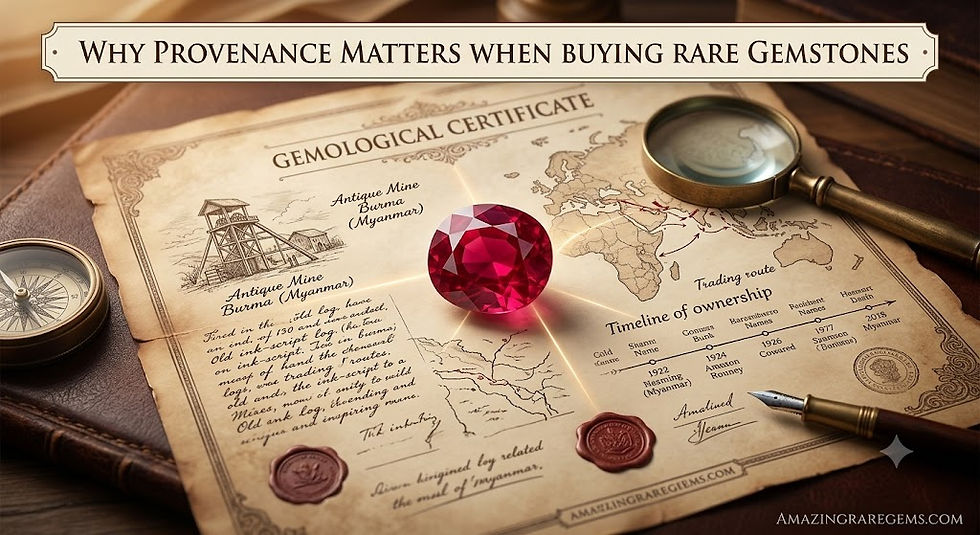
Provenance Can Add Another Dimension
A gemstone with documented history, previous ownership records or detailed acquisition information may be more attractive to collectors.
Good provenance enhances confidence and can increase desirability, particularly for exceptionally rare gemstones or historically significant specimens. See our recent post on Rare Gemstone Provenance
Market Conditions Matter
Like many collectible assets, gemstone values change over time. Factors influencing prices include:
availability of new discoveries
international demand
auction results
economic conditions
collector interest
Unlike publicly traded investments, gemstone prices generally evolve gradually, making careful selection more important than short-term market movements.
There Is No Single Formula
Unlike diamonds, which have internationally recognised pricing guides, rare coloured gemstones cannot be valued using a simple formula.
Every gemstone is unique.
Professional valuers and experienced collectors consider the complete combination of:
rarity
colour
clarity
cut
size
treatments
origin
certification
provenance
current market demand
It is this combination that determines a gemstone's true market value.
Choosing Quality Over Size
One mistake many first-time buyers make is focusing primarily on carat weight.
Experienced collectors often prefer purchasing a smaller gemstone with exceptional colour and quality rather than a much larger stone of average appearance.
Over time, outstanding quality tends to remain desirable regardless of changing market trends.
Buying with Confidence
Purchasing a rare gemstone should never be rushed. Ask questions, request documentation where available, and buy from sellers who are transparent about the gemstone's history, treatments and characteristics.
A beautiful gemstone backed by expert knowledge and honest disclosure provides far greater long-term satisfaction than simply choosing the largest stone within a budget.
A Carefully Curated Collection
At Amazing Rare Gems, every gemstone has been personally selected over more than 30 years of collecting.
Each stone has been chosen for its rarity, beauty and collector appeal—not simply because it is large or fashionable.
Where available, gemstones are accompanied by laboratory reports, documentation and provenance to help buyers make informed decisions with confidence.
Final Thoughts
Rare gemstones are valued through a careful balance of science, beauty and scarcity.
No single characteristic determines a gemstone's worth. Instead, value is created by the unique combination of colour, clarity, cut, size, rarity, origin and market demand.
By understanding these factors, buyers can better appreciate what makes one gemstone truly exceptional—and why the finest examples continue to captivate collectors around the world.
Comments